Note
Go to the end to download the full example code.
Gaussians
This example illustrates ABX discriminability on the simplest possible classes: samples drawn from
Gaussians. We start in 2D for visual intuition, then move to 1D where the ABX score admits a closed
form and we can check fastabx against the theoretical value.
Throughout, we use the Euclidean distance.
import math

import matplotlib.pyplot as plt
import numpy as np

from fastabx import Dataset, Score, Task
Two 2D Gaussians
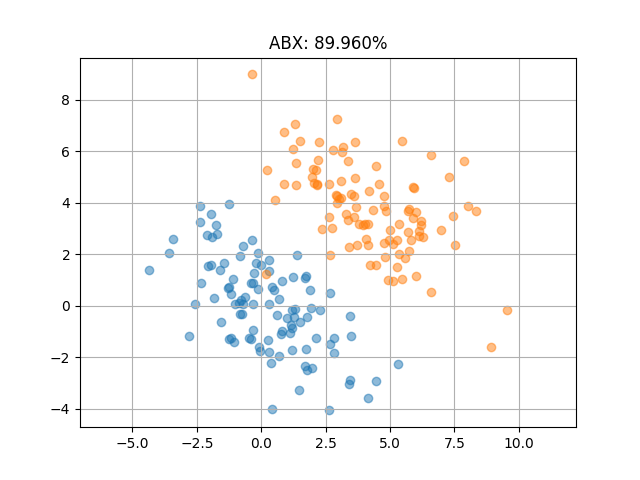
We draw two clusters from \(\mathcal{N}(\mu_A, \Sigma)\) and \(\mathcal{N}(\mu_B, \Sigma)\) with a shared (correlated) covariance and a fixed diagonal shift between the means. The reported ABX error rate is the probability that a sample drawn from class \(A\) ends up closer to a class-\(B\) sample than to another class-\(A\) sample. Well-separated clouds give a rate near 0.
n = 100
diagonal_shift = 4
mean = np.zeros(2)
cov = np.array([[4, -2], [-2, 3]])

rng = np.random.default_rng(seed=0)
first = rng.multivariate_normal(mean, cov, n)
second = rng.multivariate_normal(mean + np.ones(2) * diagonal_shift, cov, n)

dataset = Dataset.from_numpy(np.vstack([first, second]), {"label": [0] * n + [1] * n})
task = Task(dataset, on="label")
score = Score(task, "euclidean")

plt.scatter(*first.T, alpha=0.5)
plt.scatter(*second.T, alpha=0.5)
plt.axis("equal")
plt.grid()
plt.title(f"ABX error rate: {score.collapse():.3%}")
plt.show()
Scoring each cell:   0%|          | 0/2 [00:00<?, ?it/s]
Scoring each cell: 100%|██████████| 2/2 [00:00<00:00, 354.50it/s]
Two 2D Gaussians with increasing shift
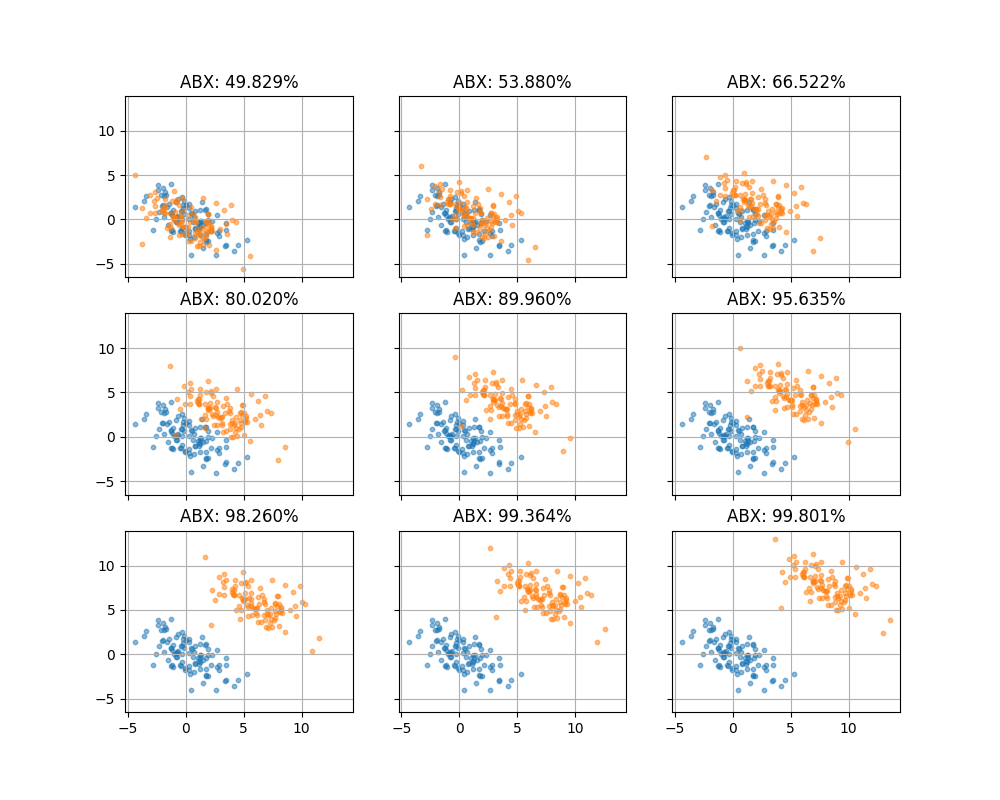
Now we keep the same covariance for both classes and sweep the displacement between their means along the diagonal. The error rate falls from chance level, 0.5 with fully overlapping clouds, down toward \(0\) as the clusters separate.
n = 100
shift = np.ones(1)
mean = np.zeros(2)
cov = np.array([[4, -2], [-2, 3]])

rng = np.random.default_rng(seed=0)
first = rng.multivariate_normal(mean, cov, n)
second = rng.multivariate_normal(mean, cov, n)

fig, axes = plt.subplots(figsize=(10, 8), nrows=3, ncols=3, sharex=True, sharey=True)
for ax in axes.flatten():
    dataset = Dataset.from_numpy(np.vstack([first, second]), {"label": [0] * n + [1] * n})
    task = Task(dataset, on="label")
    score = Score(task, "euclidean")

    ax.scatter(*first.T, s=10, alpha=0.5)
    ax.scatter(*second.T, s=10, alpha=0.5)
    ax.grid()
    ax.set_title(f"ABX error rate: {score.collapse():.3%}")
    second += shift

plt.show()
Scoring each cell:   0%|          | 0/2 [00:00<?, ?it/s]
Scoring each cell: 100%|██████████| 2/2 [00:00<00:00, 263.69it/s]

Scoring each cell:   0%|          | 0/2 [00:00<?, ?it/s]
Scoring each cell: 100%|██████████| 2/2 [00:00<00:00, 498.31it/s]

Scoring each cell:   0%|          | 0/2 [00:00<?, ?it/s]
Scoring each cell: 100%|██████████| 2/2 [00:00<00:00, 501.77it/s]

Scoring each cell:   0%|          | 0/2 [00:00<?, ?it/s]
Scoring each cell: 100%|██████████| 2/2 [00:00<00:00, 595.40it/s]

Scoring each cell:   0%|          | 0/2 [00:00<?, ?it/s]
Scoring each cell: 100%|██████████| 2/2 [00:00<00:00, 697.02it/s]

Scoring each cell:   0%|          | 0/2 [00:00<?, ?it/s]
Scoring each cell: 100%|██████████| 2/2 [00:00<00:00, 392.89it/s]

Scoring each cell:   0%|          | 0/2 [00:00<?, ?it/s]
Scoring each cell: 100%|██████████| 2/2 [00:00<00:00, 459.60it/s]

Scoring each cell:   0%|          | 0/2 [00:00<?, ?it/s]
Scoring each cell: 100%|██████████| 2/2 [00:00<00:00, 413.64it/s]

Scoring each cell:   0%|          | 0/2 [00:00<?, ?it/s]
Scoring each cell: 100%|██████████| 2/2 [00:00<00:00, 540.40it/s]
Closed-form ABX for two 1D Gaussians
In 1D with a shared variance, the ABX score can be written in closed form, which makes it a good sanity check for the implementation. Let \(A = \mathcal{N}(\mu_a, \sigma^2)\) and \(B = \mathcal{N}(\mu_b, \sigma^2)\), and write the normalized separation \(t = (\mu_a - \mu_b) / \sigma\). The probability of a correct decision is
where \(a \sim A\), \(x \sim A\), \(b \sim B\) are mutually independent. The ABX error
rate that fastabx reports is its complement,
The result depends only on \(t\): the error rate equals \(\tfrac{1}{2}\) at \(t = 0\), tends to \(0\) as \(|t| \to \infty\), and is symmetric under \(\mu_a \leftrightarrow \mu_b\).
Derivation
Step 1: reduce the event to a product of two Gaussians. Both distances are nonnegative, so squaring preserves the inequality:
Expanding, cancelling \(x^2\), and factoring gives
Introducing \(U = a-b\) and \(V = a+b-2x\),
Step 2: joint distribution of \(U\) and \(V\) . Both are linear combinations of independent Gaussians, hence jointly Gaussian. With \(m = \mu_a - \mu_b\),
Zero covariance for jointly Gaussian variables implies independence:
Step 3: factor the probability. For independent \(U, V\),
With \(p = \mathbb{P}(U>0)\) and \(q = \mathbb{P}(V>0)\), this rearranges to
Step 4: evaluate. For \(W \sim \mathcal{N}(\mu_W, \sigma_W^2)\),
Applied to \(U\) (\(\sigma_U = \sqrt{2}\,\sigma\)) and \(V\) (\(\sigma_V = \sqrt{6}\,\sigma\), \(\mu_V = -m\)),
using \(\sqrt{2}\cdot\sqrt{6} = 2\sqrt{3}\) and \(\operatorname{erf}(-z) = -\operatorname{erf}(z)\). Substituting back,
Empirical vs theoretical ABX in 1D
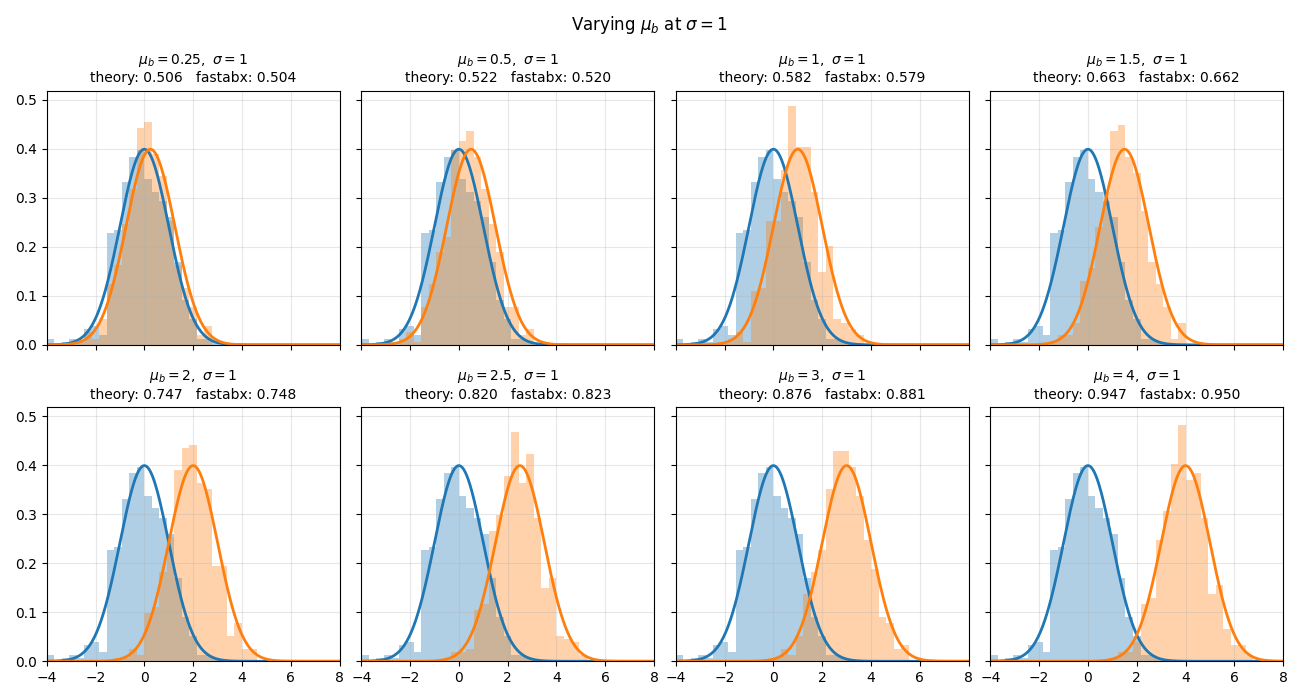
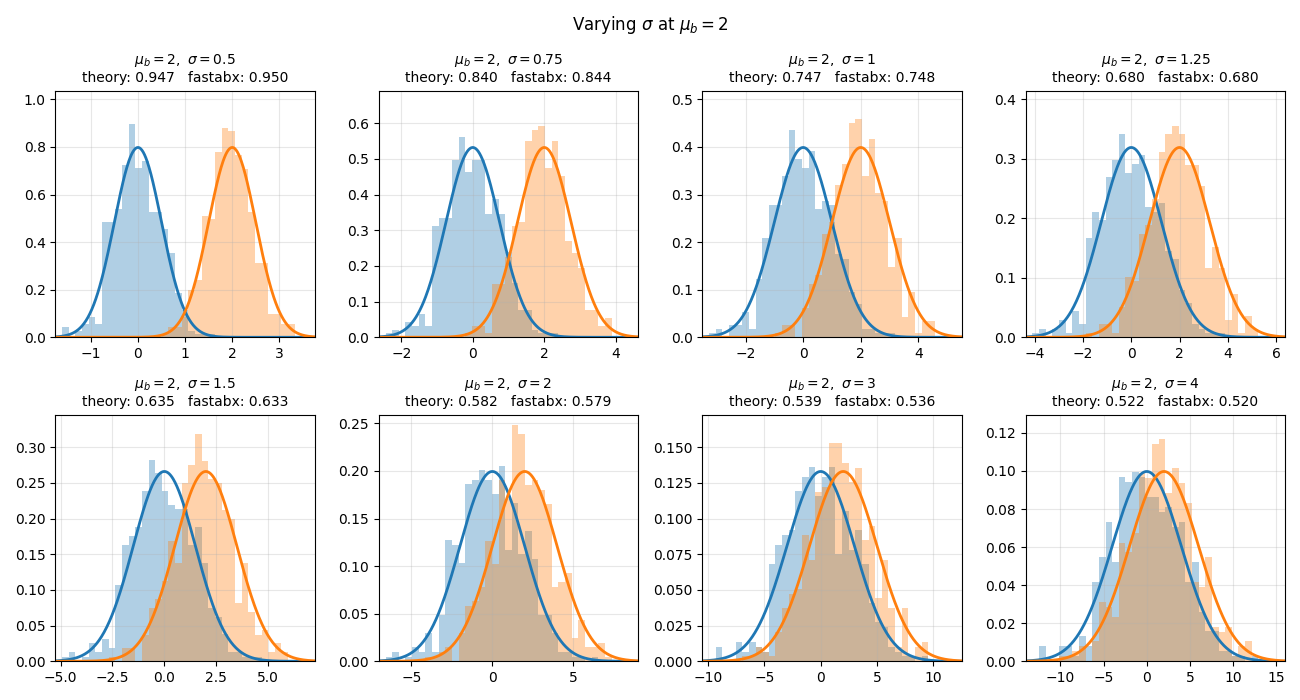
We can now check the formula above against fastabx. The helpers below sample \(n = 500\)
points from each class, compute the empirical ABX error rate with Score(Task(...)), and compare
it to theoretical_abx_error. Each panel overlays the true densities and the sample histograms,
with the two error rates shown in the title. We then sweep one parameter at a time: \(\mu_b\)
at fixed \(\sigma\), then \(\sigma\) at fixed \(\mu_b\).
def theoretical_abx_error(mu_a: float, mu_b: float, sigma: float) -> float:
    """Closed-form ABX error rate for two 1D Gaussians with shared variance."""
    t = (mu_a - mu_b) / sigma
    return 0.5 - 0.5 * math.erf(t / 2) * math.erf(t / (2 * math.sqrt(3)))


def empirical_abx_error(a: np.ndarray, b: np.ndarray) -> float:
    """Empirical ABX error rate on two 1D samples computed with ``fastabx``."""
    features = np.concatenate([a, b]).reshape(-1, 1)
    labels = {"label": [0] * len(a) + [1] * len(b)}
    dataset = Dataset.from_numpy(features, labels)
    return Score(Task(dataset, on="label"), "euclidean").collapse()


def gaussian_pdf(x: np.ndarray, mu: float, sigma: float) -> np.ndarray:
    """Density of the normal distribution with mean ``mu`` and standard deviation ``sigma``."""
    return np.exp(-0.5 * ((x - mu) / sigma) ** 2) / (sigma * math.sqrt(2 * math.pi))


def plot_panel(
    ax: plt.Axes,
    mu_a: float,
    mu_b: float,
    sigma: float,
    x_range: tuple[float, float] | None,
    n: int,
    seed: int,
) -> None:
    """Draw one panel comparing the theoretical and empirical ABX error rates."""
    rng = np.random.default_rng(seed)
    a = rng.normal(mu_a, sigma, n)
    b = rng.normal(mu_b, sigma, n)
    if x_range is None:
        pad = 3.5 * sigma
        lo, hi = min(mu_a, mu_b) - pad, max(mu_a, mu_b) + pad
    else:
        lo, hi = x_range
    grid = np.linspace(lo, hi, 400)
    bins = np.linspace(lo, hi, 40).tolist()

    ax.hist(a, bins=bins, density=True, alpha=0.35, color="C0")
    ax.hist(b, bins=bins, density=True, alpha=0.35, color="C1")
    ax.plot(grid, gaussian_pdf(grid, mu_a, sigma), color="C0", lw=2)
    ax.plot(grid, gaussian_pdf(grid, mu_b, sigma), color="C1", lw=2)
    ax.set_xlim(lo, hi)
    peak = 1.0 / (sigma * math.sqrt(2 * math.pi))
    ax.set_ylim(0, 1.3 * peak)
    ax.grid(alpha=0.3)

    theory = theoretical_abx_error(mu_a, mu_b, sigma)
    empirical = empirical_abx_error(a, b)
    ax.set_title(
        rf"$\mu_b={mu_b:g},\ \sigma={sigma:g}$"
        + "\n"
        + f"error rate — theory: {theory:.3f}   fastabx: {empirical:.3f}",
        fontsize=10,
    )
Varying the mean separation (fixed \(\sigma = 1\), \(\mu_a = 0\))
n = 500
seed = 0
mu_a = 0.0
sigma = 1.0
mu_bs = [0.25, 0.5, 1.0, 1.5, 2.0, 2.5, 3.0, 4.0]
x_range = (-4.0, 8.0)

fig, axes = plt.subplots(figsize=(13, 7), nrows=2, ncols=4, sharex=True, sharey=True)
for ax, mu_b in zip(axes.flatten(), mu_bs, strict=True):
    plot_panel(ax, mu_a, mu_b, sigma, x_range, n, seed)
fig.suptitle(rf"Varying $\mu_b$ at $\sigma={sigma:g}$")
fig.tight_layout()
plt.show()
Scoring each cell:   0%|          | 0/2 [00:00<?, ?it/s]
Scoring each cell:  50%|█████     | 1/2 [00:00<00:00,  5.43it/s]
Scoring each cell: 100%|██████████| 2/2 [00:00<00:00,  5.44it/s]
Scoring each cell: 100%|██████████| 2/2 [00:00<00:00,  5.43it/s]

Scoring each cell:   0%|          | 0/2 [00:00<?, ?it/s]
Scoring each cell:  50%|█████     | 1/2 [00:00<00:00,  5.52it/s]
Scoring each cell: 100%|██████████| 2/2 [00:00<00:00,  5.54it/s]
Scoring each cell: 100%|██████████| 2/2 [00:00<00:00,  5.54it/s]

Scoring each cell:   0%|          | 0/2 [00:00<?, ?it/s]
Scoring each cell:  50%|█████     | 1/2 [00:00<00:00,  5.48it/s]
Scoring each cell: 100%|██████████| 2/2 [00:00<00:00,  5.52it/s]
Scoring each cell: 100%|██████████| 2/2 [00:00<00:00,  5.51it/s]

Scoring each cell:   0%|          | 0/2 [00:00<?, ?it/s]
Scoring each cell:  50%|█████     | 1/2 [00:00<00:00,  5.62it/s]
Scoring each cell: 100%|██████████| 2/2 [00:00<00:00,  5.60it/s]
Scoring each cell: 100%|██████████| 2/2 [00:00<00:00,  5.60it/s]

Scoring each cell:   0%|          | 0/2 [00:00<?, ?it/s]
Scoring each cell:  50%|█████     | 1/2 [00:00<00:00,  5.53it/s]
Scoring each cell: 100%|██████████| 2/2 [00:00<00:00,  5.55it/s]
Scoring each cell: 100%|██████████| 2/2 [00:00<00:00,  5.55it/s]

Scoring each cell:   0%|          | 0/2 [00:00<?, ?it/s]
Scoring each cell:  50%|█████     | 1/2 [00:00<00:00,  5.33it/s]
Scoring each cell: 100%|██████████| 2/2 [00:00<00:00,  5.29it/s]
Scoring each cell: 100%|██████████| 2/2 [00:00<00:00,  5.29it/s]

Scoring each cell:   0%|          | 0/2 [00:00<?, ?it/s]
Scoring each cell:  50%|█████     | 1/2 [00:00<00:00,  5.36it/s]
Scoring each cell: 100%|██████████| 2/2 [00:00<00:00,  5.35it/s]
Scoring each cell: 100%|██████████| 2/2 [00:00<00:00,  5.34it/s]

Scoring each cell:   0%|          | 0/2 [00:00<?, ?it/s]
Scoring each cell:  50%|█████     | 1/2 [00:00<00:00,  5.57it/s]
Scoring each cell: 100%|██████████| 2/2 [00:00<00:00,  5.49it/s]
Scoring each cell: 100%|██████████| 2/2 [00:00<00:00,  5.50it/s]
Varying the standard deviation (fixed \(\mu_a = 0\), \(\mu_b = 2\))
n = 500
seed = 0
mu_a = 0.0
mu_b = 2.0
sigmas = [0.5, 0.75, 1.0, 1.25, 1.5, 2.0, 3.0, 4.0]

fig, axes = plt.subplots(figsize=(13, 7), nrows=2, ncols=4)
for ax, sigma in zip(axes.flatten(), sigmas, strict=True):
    plot_panel(ax, mu_a, mu_b, sigma, None, n, seed)
fig.suptitle(rf"Varying $\sigma$ at $\mu_b={mu_b:g}$")
fig.tight_layout()
plt.show()
Scoring each cell:   0%|          | 0/2 [00:00<?, ?it/s]
Scoring each cell:  50%|█████     | 1/2 [00:00<00:00,  5.46it/s]
Scoring each cell: 100%|██████████| 2/2 [00:00<00:00,  5.45it/s]
Scoring each cell: 100%|██████████| 2/2 [00:00<00:00,  5.45it/s]

Scoring each cell:   0%|          | 0/2 [00:00<?, ?it/s]
Scoring each cell:  50%|█████     | 1/2 [00:00<00:00,  5.52it/s]
Scoring each cell: 100%|██████████| 2/2 [00:00<00:00,  5.53it/s]
Scoring each cell: 100%|██████████| 2/2 [00:00<00:00,  5.53it/s]

Scoring each cell:   0%|          | 0/2 [00:00<?, ?it/s]
Scoring each cell:  50%|█████     | 1/2 [00:00<00:00,  5.49it/s]
Scoring each cell: 100%|██████████| 2/2 [00:00<00:00,  5.49it/s]
Scoring each cell: 100%|██████████| 2/2 [00:00<00:00,  5.49it/s]

Scoring each cell:   0%|          | 0/2 [00:00<?, ?it/s]
Scoring each cell:  50%|█████     | 1/2 [00:00<00:00,  5.54it/s]
Scoring each cell: 100%|██████████| 2/2 [00:00<00:00,  5.64it/s]
Scoring each cell: 100%|██████████| 2/2 [00:00<00:00,  5.62it/s]

Scoring each cell:   0%|          | 0/2 [00:00<?, ?it/s]
Scoring each cell:  50%|█████     | 1/2 [00:00<00:00,  5.50it/s]
Scoring each cell: 100%|██████████| 2/2 [00:00<00:00,  5.60it/s]
Scoring each cell: 100%|██████████| 2/2 [00:00<00:00,  5.58it/s]

Scoring each cell:   0%|          | 0/2 [00:00<?, ?it/s]
Scoring each cell:  50%|█████     | 1/2 [00:00<00:00,  5.55it/s]
Scoring each cell: 100%|██████████| 2/2 [00:00<00:00,  5.59it/s]
Scoring each cell: 100%|██████████| 2/2 [00:00<00:00,  5.58it/s]

Scoring each cell:   0%|          | 0/2 [00:00<?, ?it/s]
Scoring each cell:  50%|█████     | 1/2 [00:00<00:00,  5.52it/s]
Scoring each cell: 100%|██████████| 2/2 [00:00<00:00,  5.59it/s]
Scoring each cell: 100%|██████████| 2/2 [00:00<00:00,  5.57it/s]

Scoring each cell:   0%|          | 0/2 [00:00<?, ?it/s]
Scoring each cell:  50%|█████     | 1/2 [00:00<00:00,  5.42it/s]
Scoring each cell: 100%|██████████| 2/2 [00:00<00:00,  5.53it/s]
Scoring each cell: 100%|██████████| 2/2 [00:00<00:00,  5.51it/s]
Total running time of the script: (0 minutes 11.320 seconds)